Whether ice fits a water bottle comes down to two numbers: the clear bore of the bottle's mouth (the actual hole) and the shortest dimension of the ice piece. If the piece's narrowest face is smaller than the bore, with a few millimeters to spare, it can go in. If not, it won't, however hard you shake the bottle.
Run those numbers and the answer to "bullet or cube?" is less tidy than most people expect. Bullet ice fits wide-mouth and most narrow-mouth reusable bottles, but not a standard disposable water bottle. Cube ice ranges from thin half-dice that slips through almost anything to 2-inch clear cubes that very few bottles accept.
Cap Size Is Not Hole Size

The size printed on a bottle or cap describes the closure, not the opening. The plastic of the neck wall sits inside that measurement and takes up part of it.
Nalgene's specs show how far apart the labels can be. The 32 oz narrow-mouth Oasis bottle has a 1.5 in (38 mm) cap, and the 32 oz wide-mouth bottle has a 2.5 in (63 mm) cap. Nalgene's 16 oz wide-mouth bottle lists a 2 in (53 mm) cap, so even "wide mouth" isn't one fixed size. All of these are cap figures. The hole you push ice through is smaller.
Disposable PET water and soda bottles show the gap even more clearly. Most use a 28 mm neck finish (PCO 1881), and once you subtract the neck wall, the clear opening is only about 20 mm. A bottle described as "28 mm" has a hole about the width of a nickel.
So the first step is always to measure the bore yourself, not to read the cap size off the label.
Ice Piece Dimensions, Side by Side

The other number is the ice. What matters is the smallest cross-section a piece can present to the opening, because you can always turn a piece so it goes in on its narrowest side.
| Ice type | Typical piece dimensions | Shortest dimension |
|---|---|---|
| Bullet, small setting | 21 x 31 mm | about 21 mm |
| Bullet, large setting | 25 x 31 mm | about 25 mm |
| Full dice cube | 7/8 x 7/8 x 7/8 in | about 22 mm |
| Half dice cube | 7/8 x 7/8 x 3/8 in | about 10 mm |
| Regular cube | 1 1/8 x 1 1/8 x 7/8 in | about 22 mm (but 29 mm faces) |
| Nugget | roughly 3/8 to 1/2 in on one commercial spec; varies by machine | about 10–13 mm |
| Crescent | solid curved shell; no standard dimension | depends on the machine |
| 2-inch clear cube | 2 x 2 x 2 in | about 51 mm |
Two things stand out. First, a bullet's round face is about as wide as a full-dice cube's face. Second, "cube" covers a range from about 10 mm to more than 50 mm, so "cube ice" doesn't tell you anything about fit until you know which cube.
The shortest dimension is the best case. A piece only passes on its narrowest side if it reaches the mouth lined up correctly. Regular cubes, which have 29 mm faces, often land flat and stop even when their 22 mm edge would have cleared.
Opening-by-Opening Verdicts
Leave a few millimeters of clearance. Ice that fits with no margin to spare tends to stick on the rim, especially once it starts to frost over.
Disposable PET bottle, about 20 mm clear opening
- Bullet ice: No. Even the small setting is about 21 mm across, larger than a 20 mm bore before you allow any clearance. The large setting, at 25 mm, is further off. Bullet ice won't go into a 28 mm PET bottle at either setting.
- Full dice and regular cubes: No. Both have a 22 mm minimum, and that's above 20 mm.
- Half dice: Usually yes, if you feed it in edge-first. It fits only because it's thin: the 3/8 in (about 10 mm) side gets through, while its 7/8 in faces never would.
- Nugget: Yes. Pieces of about 10–13 mm pass with room to spare and can be poured in.
Narrow-mouth reusable bottle, 38 mm cap
The bore of a 38 mm cap bottle is smaller than 38 mm, so measure it. As long as it's comfortably above 25 mm:
- Bullet ice: Yes at either setting. A 21 or 25 mm round face leaves clearance, and the 31 mm length goes in end-first.
- Full dice: Yes, since 22 mm clears.
- Regular cubes: Often, but they're the most likely to stick. The 29 mm faces leave little margin and can bridge across the mouth if two pieces arrive together.
- Half dice and nugget: Yes, easily.
Wide-mouth bottle, 53–63 mm cap
- Bullet, dice, regular cubes, nugget: All yes. Every piece in the table except the 2-inch cube is well under the bore of a typical wide mouth.
- 2-inch clear cube: Rarely. A 2 in cube measures about 51 mm on each side, and its diagonal is wider still. To get it in, you need a clear bore of more than 2 inches. A 53 mm cap leaves a bore under 51 mm once you subtract the wall, and even a 63 mm cap gives only a few millimeters of margin for a perfectly aligned cube. Most bottle mouths can't take it.
Why Nugget and Crescent Ice Behave Differently

Both look small next to a standard cube, but their shapes affect fit in opposite ways.
Nugget ice pours
Nugget ice is made up of small, irregular pieces. Each one is smaller than any bottle bore in this article, so orientation doesn't matter: whichever way a piece lands, it still fits. Because the pieces are small and numerous, they flow through a funnel or a narrow neck much like a coarse granular material. That's why nugget ice is the dependable answer for narrow mouths.
Crescent ice wedges
Crescent ice is a solid curved shell. Its long axis and curve work against you at a bottle mouth. The piece has no short dimension it naturally falls onto. It tends to hit the rim with its long axis across the opening, and the curve lets it catch on both sides of the rim at once and bridge the gap. A second crescent landing on top of it locks it in place. A crescent can look smaller than a cube and still jam where a full-dice cube would have dropped straight in. Machines also make crescents in different sizes, and there's no standard dimension, so judge one only by measuring an actual piece.
Bullet ice is the opposite of crescent ice: a round cross-section is the same in every rotation around its long axis, so once a bullet points end-first, it goes in predictably.
Verify Fit Before You Buy
Measure the bore
Take the cap off and measure the inside of the mouth, from the inner wall straight across to the inner wall. Calipers give the cleanest reading. If you're using a ruler, hold it across the widest part of the opening and read to the millimeter. Measure in two directions, because some mouths aren't perfectly round. Write down the smaller number, and treat a few millimeters below it as your practical limit.
Ask the spec sheet the right questions
When you compare ice makers, look for two things: the ice type and the piece dimensions in millimeters. "Small" and "large" settings on their own tell you nothing, because one machine's small bullet can be another's large. A 21 mm small bullet fits a 25 mm bore with room to spare but fails a 20 mm opening; a bullet a few millimeters larger fails both. If a listing doesn't give piece dimensions, assume you'll need to test.
Test a single piece
Before you commit to a machine or a bottle, try one real piece. Stand it end-first or on its narrowest edge above the bore, then drop it straight in. Then try three or four pieces at once to see whether they bridge. If a single piece only goes in when lined up perfectly, expect it to jam in normal use.
Matching a Machine to the Bottle You Use
If your bottle has a narrow or wide mouth and a test bullet passes comfortably, bullet ice is a practical home option. Check one piece against your actual bottle before you settle into a routine.
The Euhomy Dart H1 Silver Bullet Ice Maker takes 6 minutes to make 9 bullet-shaped ice cubes and makes up to 26.3 lb of ice per day from a 1.2 L water tank. It has a sturdy handle and weighs 13.38 lb.
If you mostly drink from disposable bottles or a reusable bottle with a small bore, nugget ice is the shape that fits reliably. A removable basket lets you carry ice to the sink and pour or scoop it straight into a narrow neck.
The Euhomy Pearl H1 Nugget Ice Maker has a 1.2 Qt water tank, makes up to 34 lb of ice daily, and has a 1.8 lb removable basket.
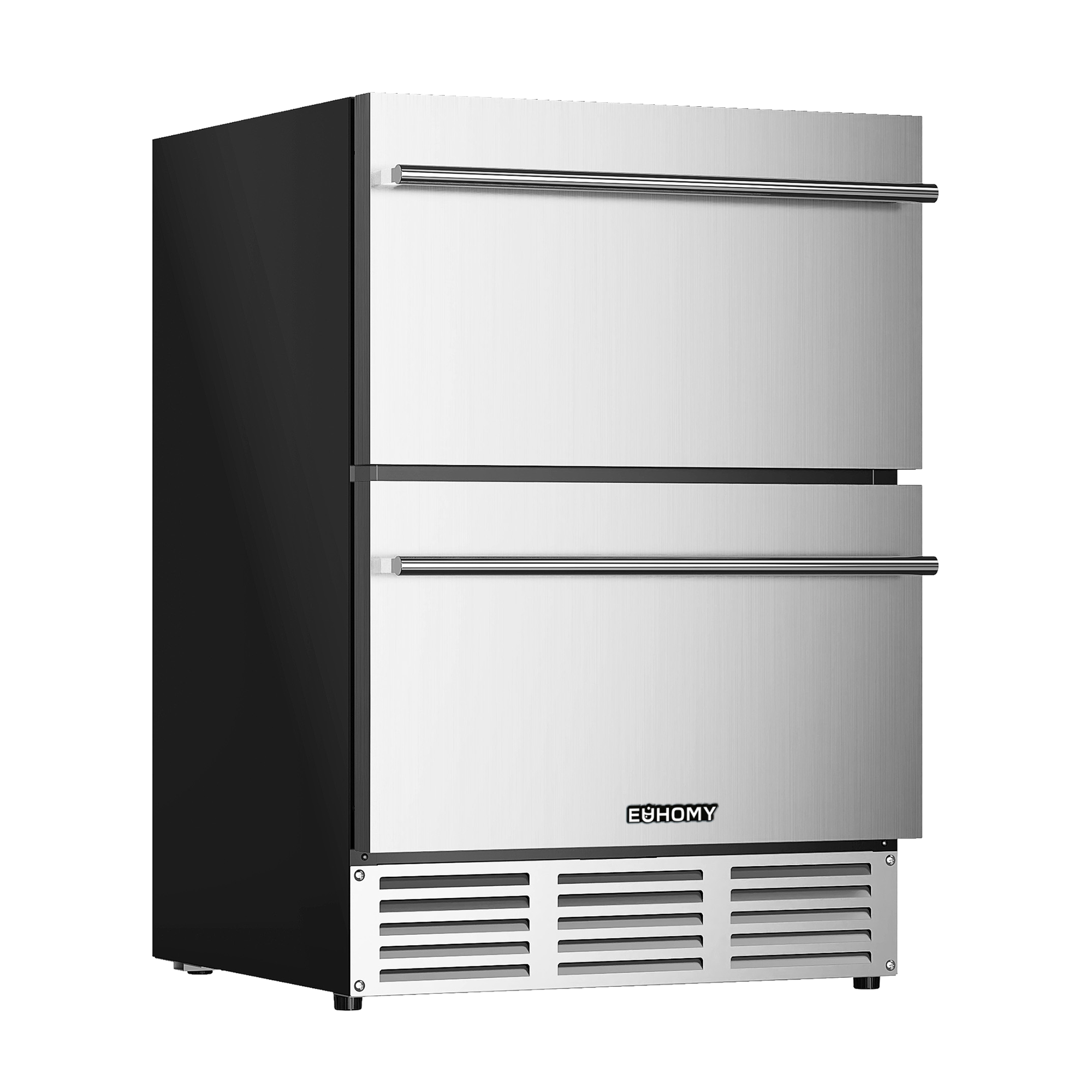
The Euhomy Countertop Clear Ice Maker is designed to produce 2-inch square ice cubes for whiskey, bourbon, cocktails, and everyday drinks.
That size is the opposite case for bottles: most bottle mouths turn it away. Use those cubes in tumblers, rocks glasses, and wide-mouth cups whose measured bore is clearly larger than 2 inches, not in a water bottle.
If Your Ice Doesn't Fit
You don't have to replace your ice maker or bottle to solve the problem.
- Switch to thinner or smaller pieces. Half-dice ice slips through narrow necks edge-first, and nugget pours through almost anything.
- Change the lid, not the bottle. Some bottle lines offer a wider-mouth top or an alternate lid. If yours does, a wider opening fixes the problem straight away. Measure the new bore first.
- Keep the ice separate. Put large cubes in a cup and pour from the bottle over them.
- Choose bottles by bore. For bullet ice, make sure the measured opening is comfortably above 25 mm. For 2-inch cubes, look for one above 51 mm with real clearance, which in practice usually means a tumbler instead of a bottle.
Measure the hole, find the ice's shortest side, and leave a few millimeters between them. That's all you need to know whether the ice will fit.