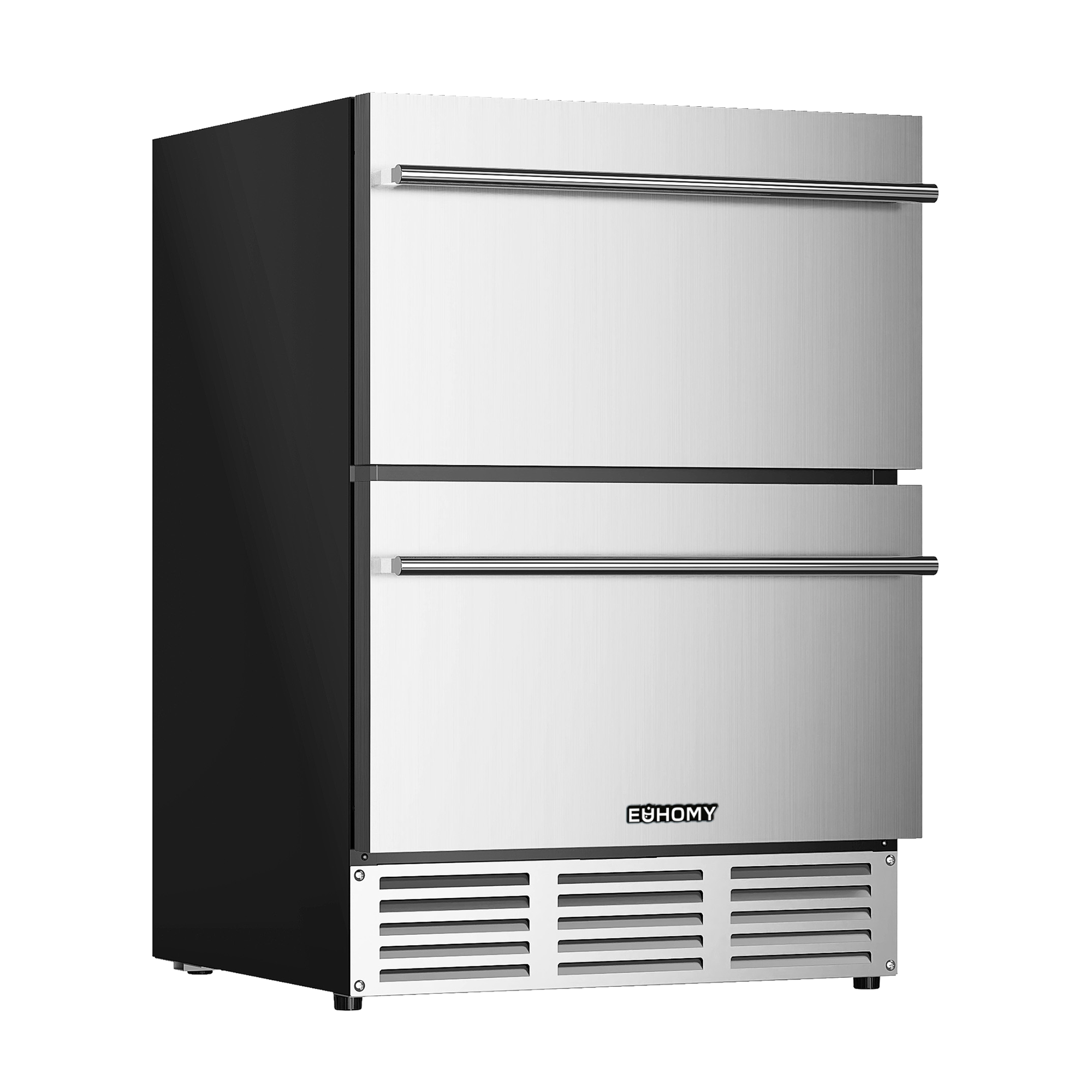
A battery that reads "full" and a fridge that says the voltage is low can both be telling the truth. They are usually measuring different things at different moments. The battery reading is often taken at the terminals with nothing drawing power. The fridge sees the voltage that actually reaches its input while the compressor is running, after the current has passed through every cable, fuse, socket and plug in between.
So the job is not to argue with the warning. It is to find where the voltage is being lost: inside the battery under load, or somewhere along the path to the fridge.
Why a full battery can still trigger the warning
Two effects stack up.
Voltage sags under load. When current flows out of a battery, its voltage drops. Some fridge manufacturers explain that battery protection systems monitor voltage while the compressor is running, rather than relying on the resting voltage. A battery can look full at the terminals, dip when the compressor starts, then recover once it shuts off.
Voltage is lost along the cable. DC voltage falls along the length of a wire, and each extra joint adds more loss. Extra splitters, pigtails and extensions can lower the voltage at the socket for this reason.
Battery protection settings vary by fridge model, but the physics of load sag and cable loss applies to any 12V compressor car fridge.
The check sequence: three readings, in order

You need a basic digital multimeter, or a plug-in socket voltmeter for the last step. Take each reading in the same way so you can compare them. Write the numbers down. The gaps between them matter more than any single value.
1. Resting voltage at the battery terminals
Switch the fridge off, or unplug it, and measure across the battery terminals. This is the "full battery" number most people already have. On its own it tells you very little about what the fridge sees.
2. Battery voltage with the compressor running
Turn the fridge on and wait until the compressor is clearly running. Measure at the battery terminals again.
- A small dip that recovers when the compressor stops is normal load behaviour.
- A large drop at the terminals themselves points to the battery: it may be ageing, partly charged despite its resting reading, or too small for the load. A battery tester or a battery shop can load-test it properly.
3. Voltage at the fridge end while it runs
With the compressor still running, measure as close to the fridge as you can, ideally at the socket the fridge plugs into. A plug-in voltmeter in that socket is the simplest way.
Compare this with reading 2. If the battery holds up under load but the socket reading is noticeably lower, the loss is in the wiring path, not the battery.
What the gap tells you
| What you see | Most likely cause | Next step |
|---|---|---|
| Battery drops sharply under load | Battery condition or capacity | Load-test or charge the battery fully; replace it if it fails |
| Battery holds, socket reads much lower | Cable length, a poor contact, or adapters | Work through the connection checks below |
| Readings stable, warning only on some outlets | That outlet's wiring or plug fit | Try a different outlet that is direct to the battery |
| Readings stable everywhere, warning persists | Fridge setting, plug lead or the fridge itself | Check the manual's protection setting, then contact support |
Connection checks that need no rewiring

Work from the fridge back toward the battery:
- Remove anything in the middle. Unplug splitters, multi-socket adapters and extension leads and plug the fridge's own DC cable straight in.
- Check the plug fit. A cigarette-style plug that is loose or wobbles in the socket can lose contact under load. Look for a plug that feels warm, discoloured contacts, or a warning that comes and goes when the vehicle moves.
- Inspect the lead. Look for kinks, crushed sections or damaged insulation along the fridge's DC cable.
- Try another socket. Some vehicles have outlets on thinner or longer wiring than others, or outlets that switch off with the ignition.
- Rule out the power source. If you can, run the fridge from a different supply. Then take the same readings again.
A warm plug, melted plastic or a burning smell means you should stop using that outlet. Have the vehicle's wiring inspected by a qualified auto electrician, and do not bypass the fridge's battery protection to keep it running.
Using a second power path to isolate the fault
The Euhomy Rover H1 car refrigerator comes with both 120/240V AC and 12/24V DC adapters.
If your fridge can run from more than one kind of supply, that gives you a quick way to tell a fridge fault from a vehicle-wiring fault. Plug it into a household outlet with its AC adapter and let it run through a few compressor cycles. If it runs normally on AC but warns on the vehicle's DC socket, focus on the battery and the vehicle wiring. If it shows a problem on both supplies, the issue is more likely in the fridge or its adapters. That is the point to stop troubleshooting and contact the manufacturer's support with your three readings and which supplies you tried.
When to hand it off
Escalate rather than keep adjusting if:
- the battery fails a load test or won't hold a charge;
- the voltage loss is clearly in the vehicle's fixed wiring, not in a removable adapter or lead;
- the fridge warns on every power source you try.
The first two are jobs for a battery specialist or auto electrician. The third goes to the fridge manufacturer. In every case, the readings you took at rest, under load and at the fridge end will make the diagnosis faster.