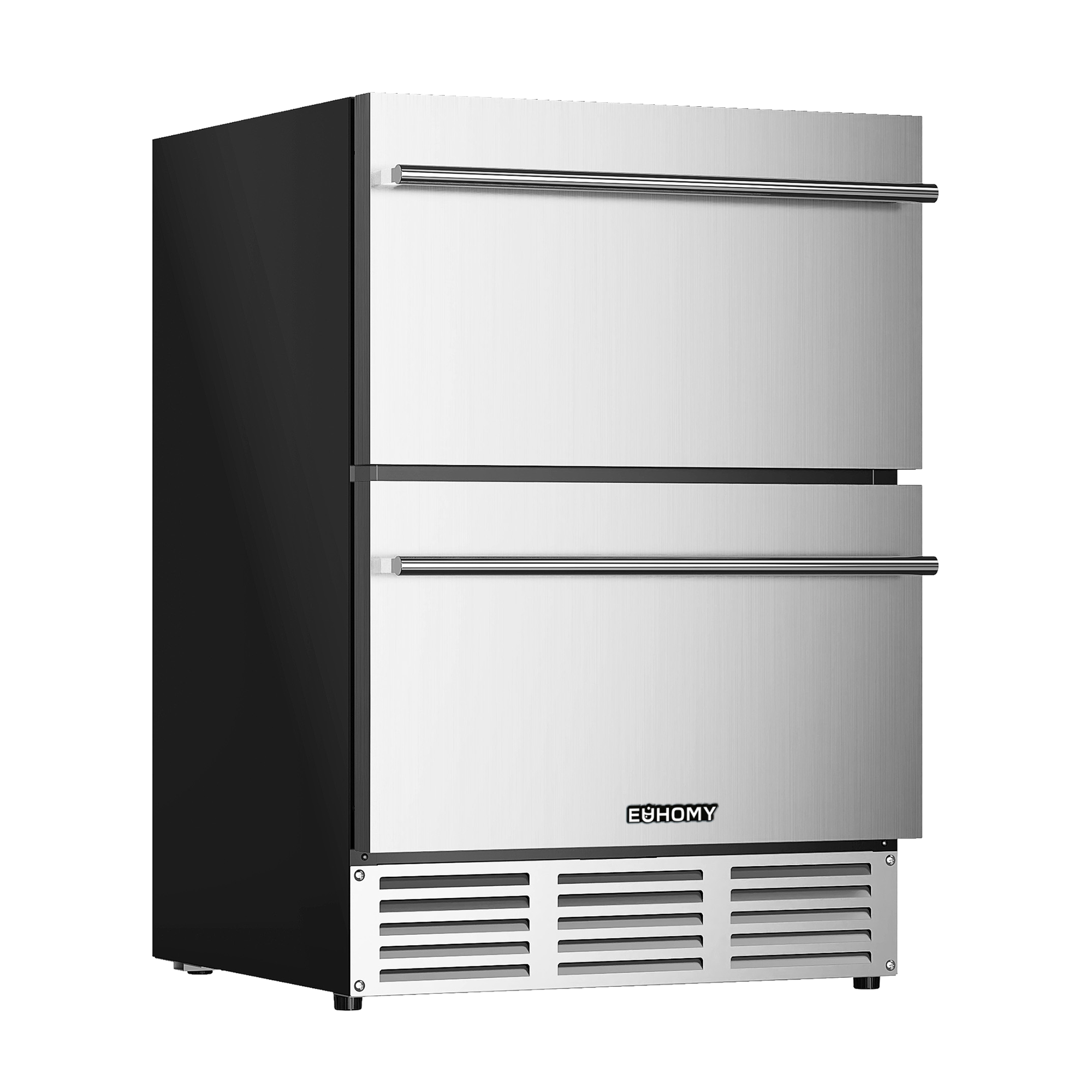
If you want crystal-clear cubes for a few good cocktails, the choice isn't really "machine vs. mold." The real choice is which workflow you'll actually stick with. A mold costs less up front but asks for planning, freezer space and some handling. A dedicated clear ice machine moves most of that work onto the countertop, but you pay more and it takes up permanent space. Before comparing the two, check one thing: is the mold you're looking at a clear-ice mold at all?
Quick decision
Which Ice-Making Option Should You Choose?
- Directional-Freezing Mold
- You need a few clear cocktail cubes occasionally and can freeze them ahead.
- Clear Ice Machine
- You serve clear ice frequently and prefer to skip advance freezer batches.
- Nugget Ice Maker
- You mainly want plenty of chewable ice for iced coffee, soda, and other everyday drinks.
A standard silicone tray shapes ice. For clear cubes, choose an insulated directional-freezing mold.
A regular silicone mold isn't a clear-ice mold

Lots of people buy a large-cube silicone tray, freeze it and get cloudy blocks. The tray works fine. It just freezes the water from every side at once.
Clear-ice molds use a method called directional freezing. Glacio's guide explains how directional freezing works: in an insulated container with an open top, ice forms mostly from the top down. Air and dissolved material get pushed toward the water that freezes last, so the cloudiness collects there instead of spreading through the whole cube.
So you're really choosing among three things:
- Standard silicone molds give you big cubes or spheres in useful shapes, but they usually come out cloudy.
- Directional-freezing molds use an insulated container so clear ice forms in a predictable direction. They're the real alternative to a clear ice machine.
- Clear ice machines are countertop appliances built to make clear cubes automatically.
If clarity matters to you, compare the second and third options. A plain silicone tray is a shape tool, not a clarity tool.
Cost: up-front price vs. ongoing effort
A mold is the cheaper way to try clear ice, and you can stop using it with little regret. You're already paying for your freezer, so the extra cost is mostly a container and some freezer space.
A machine costs much more at the start. It only makes sense if it replaces work you would really do, often. Prices change a lot between models and sales, so compare the current prices of the specific mold and machine you're considering. A rule of thumb won't help much here.
A useful question to ask yourself: how many clear cubes do I serve in a typical week? If the answer is a handful, a mold is hard to beat on value. If you regularly host, or you'd use clear ice every evening, the machine's convenience starts to pay for itself in effort saved.
Freezing wait: planned batches vs. on-demand

The biggest workflow difference is timing.
A directional-freezing mold works in batches. You fill it, freeze it, take it out and release the cubes. Freeze time depends on your freezer and the mold's size, so check the maker's instructions. Either way, you need to plan ahead. For a Saturday gathering, the ice is a Thursday or Friday job. Most mold users keep finished cubes stored in the freezer so they always have some ready.
A machine shortens the planning. You still wait for each cycle, but you don't need to set aside freezer space or remember to start a batch. If your cocktails are spur-of-the-moment, this matters more than anything else in the comparison.
Batch quantity: how much ice per round
Molds make a fixed, small number of cubes per batch. Glacio's Duo molds, for example, make two cubes or two spheres per container. Two cubes is plenty for a nightcap but not for a party. To make more, you can buy more molds if your freezer has room, or run batches ahead and store the finished cubes.
A machine makes cubes continuously while it's running and stocked with water. That suits a steady routine. Before buying, check the manufacturer's stated output and storage capacity against your real peak demand.
Operating effort: what each workflow asks of you
With a mold, the work is manual but simple. Fill to the marked line, align any inserts, freeze, release, and sometimes trim off the cloudy part that froze last. Storage is part of the job too. Bag or box finished cubes so they don't pick up freezer odors or stick together.
With a machine, you have less hands-on work per cube, and more of it is upkeep: refilling water, emptying, and cleaning on the schedule in the manual. You also need a permanent spot on the counter.
Neither option is effortless. The mold's work comes in short bursts you schedule yourself. The machine's work is ongoing appliance care.
If your drinks don't actually need clear cubes
Some readers who search "clear ice maker" really want plenty of good ice for iced coffee, soda, highballs or blended drinks, where clarity barely matters. Nugget ice is a different product category. It's soft, small and made for volume, not for a slow-melting cube in a rocks glass. If that's your routine, a countertop nugget ice maker solves a different problem. It isn't a clear-ice machine.
The Euhomy Pearl H1 Nugget Ice Maker is a countertop nugget ice maker with a refillable 1.2Qt water tank. Euhomy rates it at up to 34 lbs of ice daily, with a 1.8 lbs removable basket. Its listed dimensions are 9.45"D x 11.61"W x 12.99"H.
The Euhomy Pearl L1 Plus Nugget Ice Maker uses a 1.8L refillable water tank. Euhomy rates it at about 44 pounds of pebble ice within 24 hours. Its listed dimensions are 9.84"D x 13.98"W x 14.96"H.
Both output figures are manufacturer ratings, not amounts measured in a home kitchen. Your results will depend on your conditions. Many home bars use both kinds of ice: a mold for clear cubes in spirit-forward drinks, and nugget ice for everything else.
A quick decision test
Picture your next three weeks of drinks and answer honestly:
- Do you serve clear-cube drinks more than a few times a week, often without planning ahead? If yes, a clear ice machine is worth pricing out.
- Can you set aside freezer space and start a batch a day or two before you need it? If yes, a directional-freezing mold gives you clear ice for much less money. Start with one and add more only if you keep running out.
- Is the ice mostly for volume, like iced coffee, soda or pitchers? If yes, skip clear ice and look at a nugget ice maker sized to your counter.
If you aren't sure, start with a directional-freezing mold. It's a cheap way to learn how much clear ice you actually use. That gives you a real number to judge a machine against.